Taiwan’s Own Budget Airlines Set to Soar
Lin Hsin-ching / photos Chuang Kung-ju / tr. by Geof Aberhart
January 2014


Taiwan’s own budget airlines are about to take flight! Both Taiwan’s leading airline China Airlines, and TransAsia Airways, the standout performer of recent years, announced their own low-cost subsidiaries in 2013, and both are expected to start flying to major cities in Northeast Asia, Southeast Asia, and Greater China by the end of 2014.
In December 2013 Japan’s Vanilla Air—a subsidiary of All Nippon Airways formerly known as AirAsia Japan—joined the heated fight over flights between Taiwan and Japan, offering one-way flights between Taipei and Tokyo for just NT$388; once taxes at both ends are taken into account, that still amounts to a return flight between the two cities for just NT$1,888.
Offering such irresistible prices is the only way such budget airlines can stake a claim in the international air market. In 2001, budget airlines accounted for just 8% of the global market; by 2012, that had risen to 26.1%, with market share booming particularly in North America, Europe, and Southeast Asia, reaching between 30% and 40%.
Such airlines have become increasingly prominent in the Taiwanese market as well, rising from a 3.5% share in 2012 to a 5.1% share in the first half of 2013, and forecast to grow even faster in the coming few years.
There are already some 12 low-cost carriers flying 13 routes to and from Taiwan, covering destinations across Southeast Asia, Northeast Asia, and even into Shanghai. Their presence has put local Taiwanese companies under a level of pressure they cannot afford to ignore.
For example, in 2013 TransAsia put their Taipei–Pusan and Taipei–Singapore routes on the chopping block, having been squeezed out by budget airlines; EVA Air and China Airlines, meanwhile, have started offering early-bird and credit-card discounts in response to the threat. However, there is only so much cheaper traditional airlines can make their flights, given the demand for full service including luggage handling and meals. No matter how brilliant their marketing, there is only so far they can go against the advertised ticket prices of budget airlines, who charge extra for in-flight services.
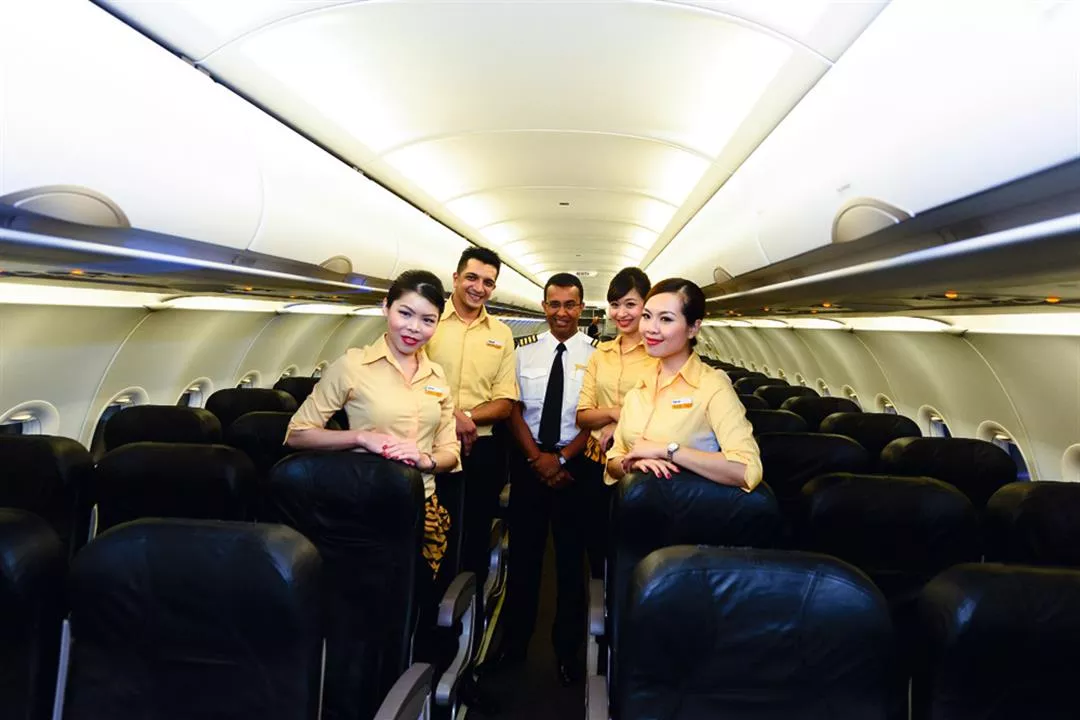
Tigerair has a youthful, lively image that should go down well with backpackers.
Taiwan’s airline industry has long recognized the threat these foreign budget airlines pose, TransAsia particularly so given the high overlap between their customer base and that of the budget airlines. In response, TransAsia chairman Vincent Lin called on Taiwan’s government to create a more favorable environment for local airlines and called for the prompt establishment of Taiwan’s own budget carriers.
The Civil Aeronautics Administration has played an important part in this regard. In July 2013, the CAA announced a reduction in the share capital needed for the establishment of an airline, as well as encouraging secondary airports to host international routes and setting landing fees between 30% and 50% lower for them.
This creation of a friendlier environment has allowed the comparatively smaller airline TransAsia to finally throw its hat into the budget airlines ring, announcing in November 2013 the establishment of Taiwan’s first such carrier and holding a high-profile competition to name the brand, offering ten years of free flights as the winning prize.
China Airlines, meanwhile, has decided to fire back by inking an agreement with Singapore’s Tiger Airways (which flies as Tigerair) to jointly establish Tigerair Taiwan. This joint venture involves a capital investment of some NT$2 billion, with China Airlines holding 90% of the company and Tigerair the remaining 10%. Tigerair Taiwan is expected to be in the air by Q4 2014 at the soonest, operating three Airbus A320s—to expand to 12 after three years—and aiming to be profitable within three years.
China Airlines chairman Sun Hung-hsiang notes that Taiwan is located in the heart of Asia, just four hours’ flight from destinations across Northeast Asia, Southeast Asia, and Greater China. With Asian nations like Japan and Singapore enacting “open skies” agreements in recent years, flight restrictions between Taiwan and mainland China loosening up, and Taiwanese becoming more and more familiar with budget carriers, the iron is hot and it’s time to strike, says Sun.
A piece of the pie, or a bigger pie?Tigerair Taiwan and TransAsia’s budget carrier will fly to and from major cities across Northeast Asia, Southeast Asia, and Greater China. But with so much overlap between these airlines and their parents, how can these companies avoid scoring own goals?
In response to this, China Airlines’ Sun has said that from his observations of the process in other countries, the budget airlines that have become so popular with backpackers can actually create more demand for travel by creating opportunities for those who can’t afford the sky-high prices for normal tickets. “Rather than further dividing up the existing customer base, we will actually be making the pie bigger for everyone,” he says.
With the coming of Taiwan’s own budget airlines, it looks like competition in the skies over Taiwan is about to get even hotter. As well as presenting another powerful way to promote our beautiful island abroad, these new companies look set to create greater competition and choice for travelers, making consumers the big winners.


@List.jpg?w=522&h=410&mode=crop&format=webp&quality=80)