The Taiwanese Way of Death:Reform in the Funeral Services Sector
Tsai Wen-ting / photos Pu Hua-chih / tr. by Christopher MacDonald
August 2001


In its June 18 issue this year, Time magazine featured a report on Taiwan's funeral services sector. Under the heading "Grave Stakes," the article described the dreadful state of Taiwan's corruption-riddled death industry.
Funeral management has always been a rather murky business in Taiwan, infested with criminal elements, and few outsiders have ever set up in the sector. Over the years, the body-snatching exploits and outrageous price-gouging of some of the worst operators, combined with the decrepit state of the funeral parlors-dismal dumps where every move seems to require a "red envelope"-have heaped misery upon mourning for countless bereaved families.
In recent years the rise of "life-death studies" has spurred academic interest in the subject. At the same time, funeral services have become increasingly consumer-oriented. Companies now provide smart, presentable directors to guide bereaved families through the entire process, and offer funeral insurance policies with fixed tariffs. Meanwhile, revised legislation has opened the way for the use of more "natural" forms of burial, which public-sector funeral establishments are actively promoting. As a result Taiwan's funeral services industry, so long considered dirty and disreputable, is coming back into the fold.
With industry, officialdom and academia working hand in hand to reform the sector, this has been dubbed "the year of funeral reform." What is the focus of the reforms, and what is the vision for the future? What changes are now taking place in the Taiwanese way of death?
Stories of unscrupulous funeral firms snatching corpses and demanding outrageous fees have become so common in Taiwan that they are barely newsworthy. Morticians, desperate to be first inside the mortuary to claim a fresh corpse, have been known to assault security guards keeping them out, and recently there was a notorious case involving a Jane Doe that a funeral firm in Hualien had been holding for two weeks. When relatives finally identified the body they were billed NT$150,000 and were told: "Pay up, or the stiff stays!" This shameful episode reached a global readership when Time magazine included it in a feature on the dire state of Taiwan's funeral industry.

Death don't come cheap
In cases of sudden death such as homicide, car wrecks and suicide, or when an unidentified corpse has been found, funeral firms rely on tip-offs from contacts among the police. Some even listen in on emergency service calls, and often get to the scene ahead of the police themselves, staking their claim as the first to "drape a shroud" over the body. When the instructor at a recent training session for funeral directors, asked participants to say which trades or people their companies had the closest connections with, the answers included the police, and neighborhood wardens. In fact, hospitals, nursing homes and day centers for the old are all divvied up among different funeral firms, each of which jealously guards its patch against competitors.
Setting aside the extreme cases reported in the papers, anyone who has had to deal with the loss of a loved one in Taiwan knows what goes on. By the time you arrive on the scene there's already a crowd of fengshui masters, Buddhist priests and florists hanging around at the door offering their services. Later, at the crematorium, you are presented, off-the-record, with a choice: hand over a "red envelope" (a bribe) and your loved one gets the slow-burn, producing ashes that are white and lustrous; no red envelope and the heat gets turned up, deforming the corpse and leaving only blackened remains.
Oftentimes, agreeing on a funeral company to take care of the arrangements is just the start of a new nightmare. For distraught relatives, whatever the company says, goes, so that even where a set quote is given, the eventual charge usually comes in at least 50% higher.
Many funeral firms have reacted against the barrage of criticism in the press, calling it unfair. Chen Yuan, whose work includes dealing with victims of sudden death, explains that his prices are fixed. "We earn our money the hard way," he says. For two people to spend the night watching over the scene of a fatal car crash until the coroner arrives-meanwhile shooing stray dogs away from the body-the charge is NT$6000. It costs NT$1200 to take down a hanging victim, and NT$3000 to clean up the scene of a death. Often, funeral firm staff are the ones who brave the stench and turn a corpse over for photographing by the police.
Despite protests from funeral firms, reports of crooked practices continue to appear in the papers. In recent years, however, and unnoticed by much of the public, reforms have begun to sweep through the industry, improving the operations of both public and private sector funeral services.
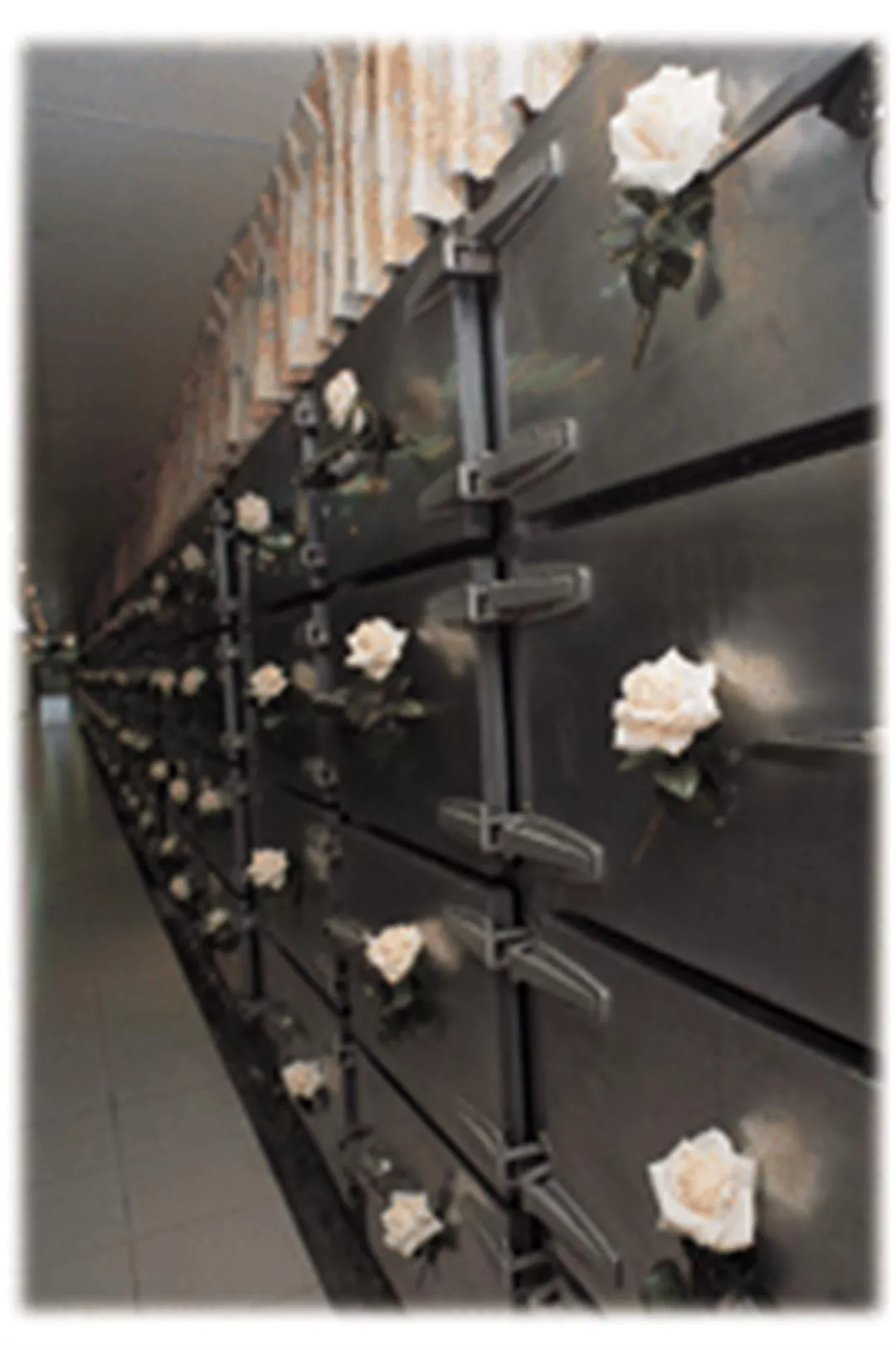
(facing page) White roses soften the appearance of the refrigeration units at Taipei No. 2 Funeral Parlor. The parlor has completely refurbished its funeral hall and the corridor along which corpses pass, and is no longer the spooky, dilapidated place that it once was.
Better service
Five or six years ago academic courses in "life-death studies" began becoming popular in Taiwan. South Taiwan's Nanhua University subsequently set up an Institute of Life-Death Studies, spurring research into funeral customs and providing training for people in the funeral business. In collaboration with the university, Bau Shan Enterprise Group, a southern Taiwan firm at the forefront of the drive for change, established a two-year junior college night-school course in funeral management, through which 20 of its own funeral directors were able to earn 80 academic credits. The university meanwhile opened extension colleges in north and central Taiwan, each offering classes in funeral management. This summer, the Taipei City Bureau of Social Affairs has been running a series of funeral management classes. All 51 places in the initial class were filled three days after registration began, so the bureau opened up two more classes. The 72-hour course covers funeral policy and legislation, funeral types, different religious attitudes to death, funeral orations, memorial services, and the layout and decoration of the funeral hall.
Most of those in the class are well-educated, second-generation funeral service providers, and 13 of them are funeral directors from one firm, each smartly dressed-in contrast to the scruffy image of their trade. Everyone is concentrating hard on the lesson, rapidly jotting notes and recording on cassette what the instructor has to say, so as not to miss a single word. To receive their certificates at the end of the course, the students have to submit a 3000-character report and pass an examination.
"Just like the teacher says, we've got the experience, but not the learning. Even though we're all second and third-generation members of the business, and know a lot about funeral protocol, we may not be aware that certain rites have a kind of grief-counseling function," says Yeh Lien-hsiang, who attended the class in company with her sister.
Marking the passage from life to death is one of the major events in human life. Like doctors and nurses, funeral service providers are there to deal with this event. So how come they have always had such a bad name-to the extent that they're even shy of passing out their business cards? During class, Fu Jen University Graduate Institute of Religious Sciences professor Cheng Chih-ming tells the students: "Funeral management is more than just a service industry, or a part of the culture: it's a humanitarian undertaking."
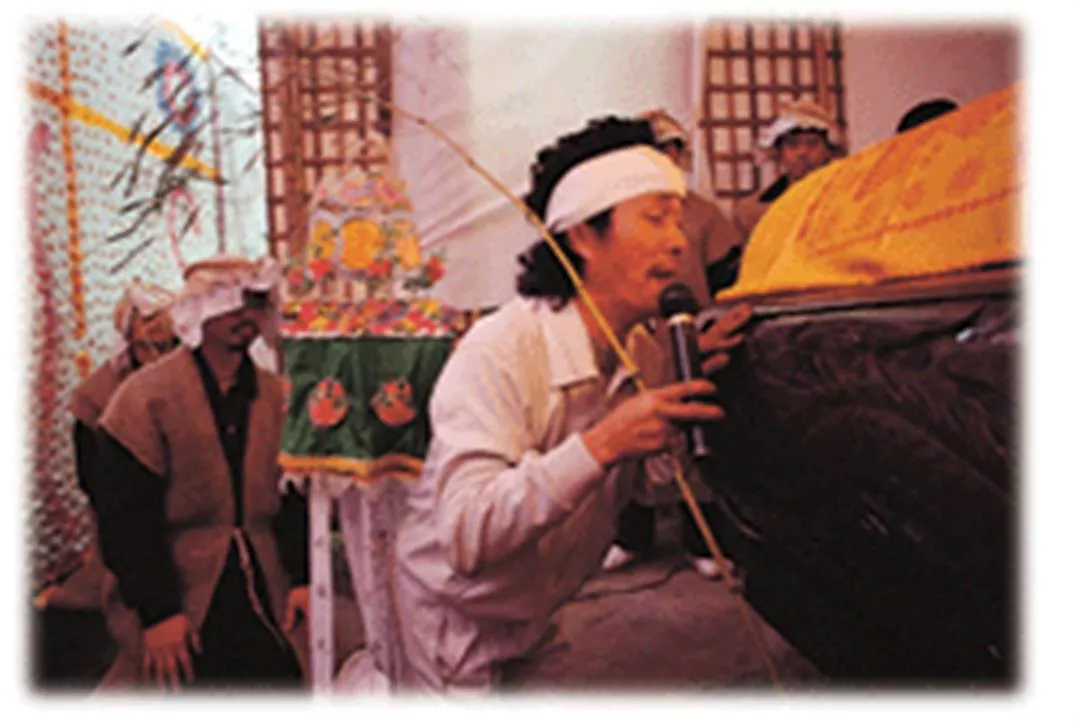
Families without a leading male mourner can recruit a "bereaved son" to sob into the microphone. The rites that make up a Chinese funeral draw deeply on cultural attitudes to death, but sometimes they are observed only in form. Hence the phenomenon of "sons" and "daughters" for hire.
Good looking guys and gals
About four or five years ago, just when academic interest in funeral services was developing, the sector began to see an influx of large enterprises. Columbarium operators moved into funeral services, with groups such as Bau Shan, Global Group, Chinpaosan and LungYen Group setting up new funeral firms and breaking the stranglehold of traditional family-run operators.
One of the new breed of corporate firms has recently set a precedent and attracted attention with a series of image-building TV commercials. And across the road from the Taipei Municipal No. 1 Funeral Parlor, several of the big operators have set up classy-looking offices with glass frontages and polished granite floors, completely transforming what used to be a depressing strip of ramshackle establishments cluttered with funerary paraphernalia.
In addition to improving their office facades, funeral firms are selling a positive image of themselves through their funeral directors-the people who work most closely with bereaved families. Twenty-six-year-old funeral director Lu Ching-feng, who resembles Hong Kong star Leslie Cheung, says that when he joined the trade three years ago, applicants were required to be at least 1.72 meters tall and hold a diploma at junior college level or above. The first thing that prospective funeral directors learn during training is not funeral customs, but emotional control, so that they can respond appropriately when being bombarded with demands from grieving relatives, who may be distraught or angry. And no matter how hot the weather, funeral directors must always appear smartly dressed before the bereaved, with neat outfits and brightly polished shoes. Very different, in other words, from the standard image of the Taiwan-style pallbearer, shuffling around in flip-flops while chomping betelnut and puffing on a cigarette.
In addition to promoting a professional image for their funeral directors, the big funeral firms have introduced a more transparent system of charges. This includes the use of funeral policies which people buy during their lifetimes, rather like life insurance, at a of cost around NT$150,000.
When the holder of a funeral policy passes away, the family calls a 24-hour hotline and a funeral director arrives within an hour to take care of the situation. The funeral director handles all the necessary arrangements, from collecting the corpse through to depositing the remains in a columbarium, and including such things as issuing obituary notices and organizing the funeral rites. At Bau Shan Funeral Company, prospective clients are even shown scale models of the articles and decor that will be used in their funerals, so they know exactly what the policy buys them.
Wu Cheng-chun, general manager of the LungYen Group, explains that his company's funeral service is organized around a simple system, in contrast to the convoluted requirements of a traditional funeral. All the essential rites are included, but not the various bizarre and superfluous additions that are often seen. The company has recruited over 50,000 policy-holders to date-virtually all of them big-city residents.

(facing page) Academia and officialdom have both become involved with funeral reform in the past few years, and staff from funeral firms can now attend special training courses to learn about the business. Classes were booked solid for one such course run by the Taipei City Department of Social Affairs this summer.
A whole new style of business
Faced with competition from the big new corporate-style funeral firms, the older, family-run outfits have had to smarten up their act. And in fact, outside of the big cities, the big firms can make little headway against local operations with a history of family involvement in the trade.
Kao Chi-chang, who originally studied film at college but this year enrolled in Nanhua University's Institute of Life-Death Studies, took over at the helm of the family firm when his father became too ill to carry on. Kao virtually grew up in a graveyard, and as a youngster he often had to watch over human bones as they dried out after being washed. When it comes to questions about traditional funeral customs, or the multitude of difficulties encountered by bereaved families, virtually nothing stumps him.
On one occasion Kao had to deal with the funeral of a man who was said to have a "broken bone" fate. According to folklore, this meant that his bones could not be gathered up from the grave for placing in the urn. To overcome the taboo, Kao shattered a porcelain bowl over the grave-"breaking a bowl instead of a bone"-and then went ahead and gathered the bones. "With a lot of these folk customs, the mourners don't feel right if the custom is not observed, and they regret it afterwards," says Kao, who is one of 28 funeral service providers officially accredited by Taipei City Government. Family-run funeral companies have started offering funeral policies too, and like the big firms, they are striving to upgrade their image. Several of Kao's uncles and aunts are also in the funeral business, supporting each other in a form of alliance, and this gives them a flexibility that enables them to compete with the big operators.

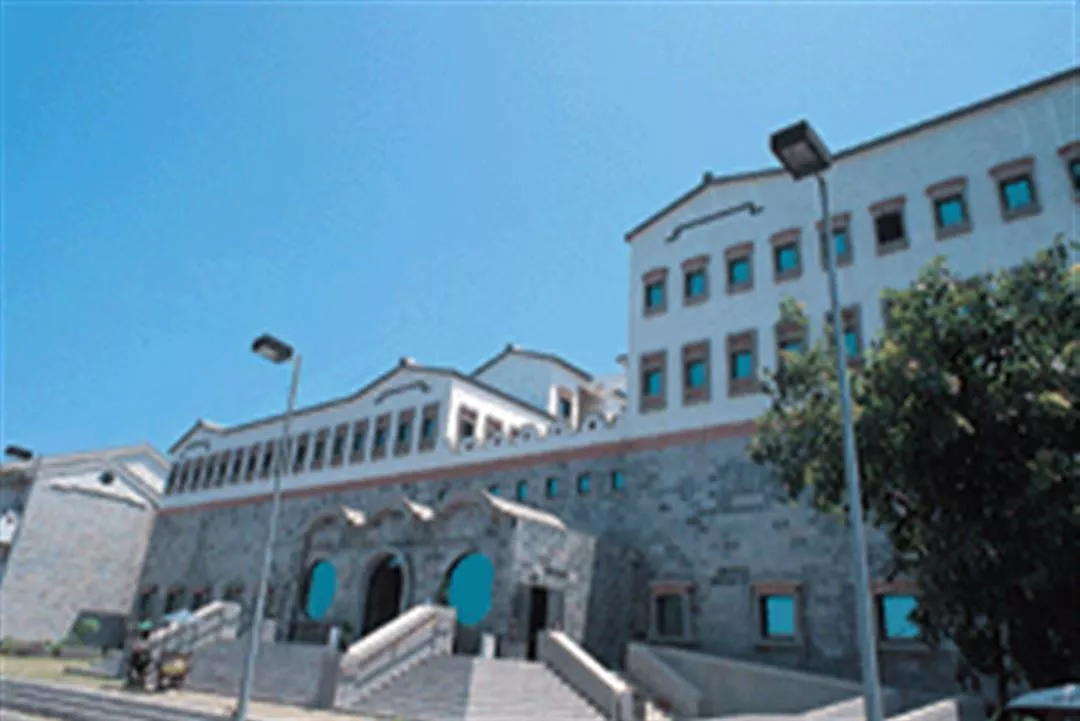
The columbarium run by Hsinchu Muncipal Funeral Management Department. It's an imposing structure, and urn space inside it is inexpensive. As a result, people from many other areas of Taiwan have opted to deposit the remains of their loved ones in Hsinchu.
Five-star mortuaries
It's not only funeral companies that deal with the business of death and its rituals. Hospitals, municipal crematoriums and funeral parlors all have their part to play. In hospitals, the mortuary is generally hidden away in the farthest corner of the grounds, but these days a number of major hospitals, including Taipei Municipal Wanfang Hospital, National Taiwan University Hospital, Hualien's Tzu-Chi Buddhist General Hospital, and Chang Gung Memorial Hospital in Linkou, have spent large sums to upgrade the quality of their mortuary facilities. Wanfang Hospital mortuary, the first to obtain ISO 9001 certification, has high-quality wooden furnishings, concealed refrigeration units, a Buddhist hall, a prayer room, and a brightly lit area for food offerings. The mortuary at National Taiwan University Hospital is around 900 square meters in area, and includes a special facility for Buddhists to carry out the prescribed eight hours of chanting alongside the body of the deceased.
Buddhism is Taiwan's largest religion, and its followers believe that after death the body should be left still for eight hours while sutras are chanted, to help the departed pass peacefully through the first phase of death. The availability of a special room for this purpose means that family members of those who die at the hospital can minimize the movement of the corpse in that initial period. It also means that Buddhists on the point of death don't have to go through the torment of being jolted back home while hooked up to a respirator, so as to be able to pass away in accordance with the traditions of their faith.
Graveyard outing
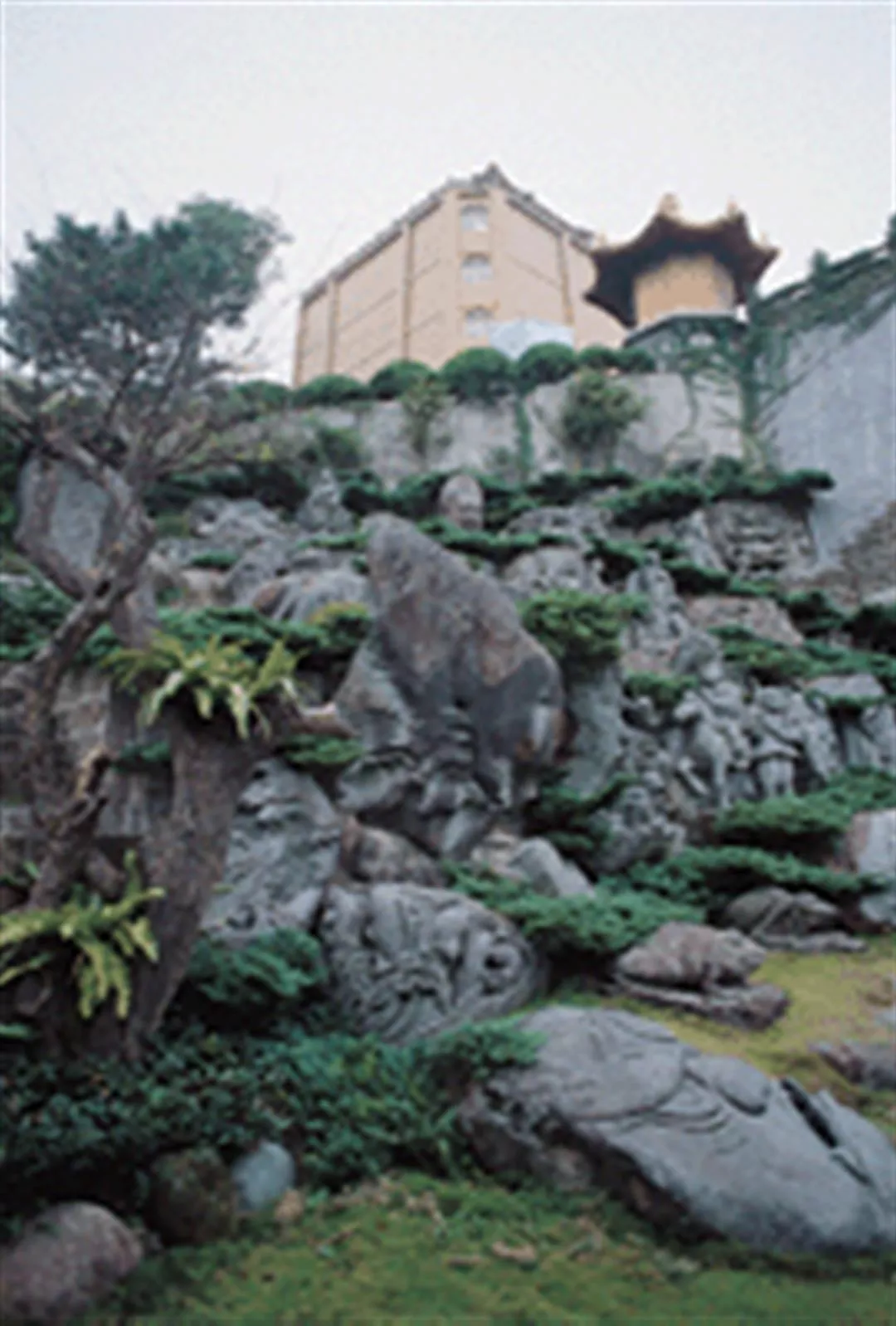
While private-sector funeral firms are competing to adapt to the new era, the old public-sector funeral parlors and crematoriums are also giving themselves a revamp. The Municipal Funeral Management Department in Hsinchu, cited by the Ministry of the Interior as a model for other operations adapting to the reforms, has built a vast new columbarium providing lovely views over the Hsiangshan Marshes, at a cost of over NT$100 million. From outside the structure resembles Tibet's Potala Palace, while the interiors are flooded with daylight, pouring in through skylights and plate-glass windows. On entering, visitors are greeted by the sight of a three-storey standing Buddha, beaming kindly on the world. Urn space in the columbarium can be purchased for a very reasonable NT$5000, and this, along with the tower's auspicious topographical location, has attracted plenty of customers from outside the county.
Tan Wei-hsin of the Funeral Management Department in Hsinchu, who holds an MA in life-death studies, says that there is a trend towards the development of memorial parks featuring museums, areas for "tree burials" (where a tree is planted over the buried body), croquet lawns, barbecue pits and so on. A funeral parlor set in such surroundings is not such a scary place, and it means that those who come on Tomb-Sweeping Festival, in the springtime, can enjoy a pleasant outing while tending to the graves of their loved ones.
Another example of a modern funeral establishment is the Garden of Fortune funeral parlor in Ilan, which is set among rolling lawns and has swans on its lake. The grounds are so pleasant that it is a popular place for couples to pose for their wedding album photographs.
Last September the Garden of Fortune set a new precedent when it mounted a concert of classical music for the public. The audience that day enjoyed an unusual new experience: aesthetic appreciation in a place created for funerals and graves.
The two funeral parlors under the administration of the Taipei Municipal Funeral Management Department handle the largest volume of funerals in Taiwan. In the past year they have taken measures to end the "red envelope culture" for which funeral parlors are notorious, while generally improving the environment and reducing costs for the bereaved. Chen Chun-sheng, head of the Taipei No. 2 Funeral Parlor, who graduated from National Institute of the Arts, brought his creative side into play when introducing the funeral parlor's "model funeral hall." The air-conditioned interior features soft colors, with white and pastel yellow drapes, and the entrance has panels of frosted glass where there would normally be a ceremonial archway festooned with plastic flowers. Among those who have held funerals at the facility, 98% have expressed satisfaction with the hall's pleasant, tastefully designed environment.
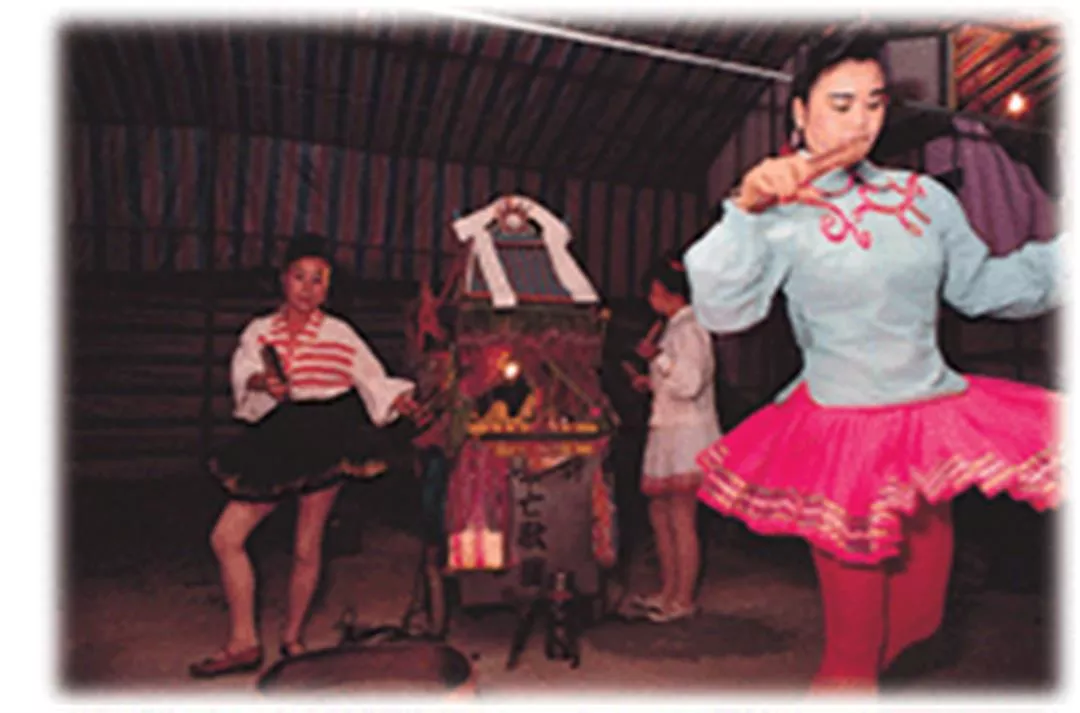
Where do we go after we die? One popular funeral ritual symbolizes pulling the soul of the deceased across to the Western Paradise. (photo by Hsueh Chi-kuang)
A little more time and space
In addition to being a local landmark, the municipal funeral department in Hsinchu has been commended for its management practices. With limited personnel to draw on, Tan Wei-hsin has contracted out services to private firms. Every year the funeral sector union selects eight morticians to work at Hsinchu, and with companies monitoring each other's performance in this way, Hsinchu can offer a professional, red-envelope-free service.
The Hsinchu funeral parlor also includes a special room where relatives can spend a final few hours with the body of their loved one, before consigning it to refrigerated storage. This gives them a chance to pay their last respects and begin coming to terms with their loss, and it also means they can watch over the corpse in case it should show signs of not being dead. Says Tan: "In the past, the body went into refrigeration the moment it arrived at the funeral parlor. The face had often turned black and rigid by the time some of the relatives arrived, which many found hard to take."

(facing page) Funeral corteges often stretch for one or two kilometers, creating serious traffic jams. In the future, it will be necessary to notify the police three days in advance.
Nutrition for trees
Funeral rituals are a manifestation of our attitudes to life and death, and changing people's attitudes is at the heart of the funeral services reforms. The Ministry of the Interior's Civil Affairs Department, which oversees funeral affairs in Taiwan, is currently working on new legislation to replace the 1983 Statute Governing Tomb Installation. "Almost 90% of the statute's 29 articles are out of touch with reality, and haven't applied in years," says Yang Kuo-chu, a specialist who was brought in to work with the Civil Affairs Department on drafting the new regulations.
The new legislation updates the definitions of "cemetery" and "funeral location," and relaxes restrictions that limit the proximity of graveyards to residential areas and schools. As cemeteries become more acceptable in the community, and more aesthetically designed, it is expected that it will become normal for funeral parlors and crematoriums to be located among residential developments, just as they are in Japan and the West.
As an indication of how attitudes have changed, it is worth noting that while cremation accounted for 30% of funerals in Taiwan in 1971, the rate had risen to over 60% in 1999, and topped 98% in urban areas such as Taipei and Hsinchu. But nationwide, there are still over 2 million vacant spaces in the columbaria, where remains are deposited for storage. The new legislation will go beyond interment and cremation to cover such alternatives as burial under a tree, burial at sea, and the scattering of ashes.
Those who choose to be buried under a tree, so as to nourish its roots, can take comfort in the knowledge they won't be competing for space with the living, while their descendants can gather in the shade of the tree to remember them. Then there's the option of having one's ashes cast on the breeze at some chosen location, leaving not a trace. "In fact," says Yang Kuo-chu, "We are well behind mainland China and Japan in terms of funeral reform." Burial under trees has long been common on the mainland. In the city of Shenyang, over 50,000 people have signed up to have their place of burial marked by a tree rather than a headstone, and in this way to return to nature when they die.
In Kaohsiung, the funeral management department has been working to promote the option of burial at sea, in accordance with regulations formulated in 1997. The department has recruited the services of 20 or so boat-owners who will take bereaved relatives out to sea, at no charge to the relatives, and allow them to drop the ashes of their loved ones into the deep in biodegradeable containers.
Life and death as one
As the reforms gather momentum they are bringing four main changes to the industry: larger corporate enterprises, modernization of facilities and services, transparency of fee scales, and landscaping of memorial grounds. But as some academics have pointed out, death is a solemn matter, and funeral reform needs to go beyond the external trappings of convenience and appearance.
Lin Ku-fang, director of the Graduate School of Art at Fokuang University, says that the current reforms place too much emphasis on the perspective of the living: "There's a real problem with reforms of this type, which is that they turn funerals into a non-religious commercial activity." Lin, who feels that Chinese funerals are secular enough as it is, would like to see reforms that give more emphasis to the sacredness of the event. Cemetery design could reflect religious notions of the next world, and there could be more participation by religious groups in the funeral rites themselves, so as to properly manifest the nature of the event.
Lin notes that every funeral marks a passage both for the dead and for the living, and leaves the living with much to ponder. The vanishing of a life involves a process, and if we wait until the last moment before confronting this, then only a passive form of relief can be obtained. If the living, and the dead, are to be spared too much regret, they should deal with death together, in advance. The only way to properly honor the dead is to think of funerals in terms of their significance for life itself.
The underlying purpose of funeral reform is not simply to create a better environment for dealing with death, but rather to encourage a more honest perspective on death. If life is "the road to death," then death is "the start of life." Only death can make life complete. The main significance of funeral reform, then, is that it enables people to regard death with a more open mind, and helps them to ready themselves for the final season of their own lives.
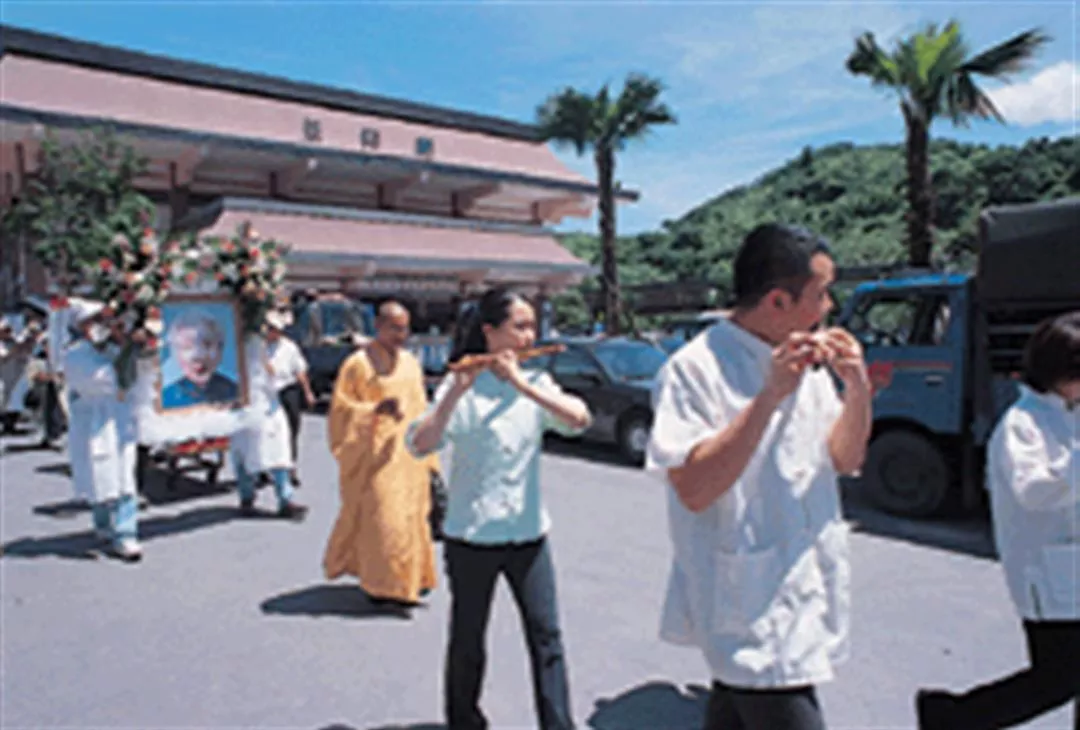
Buddhist chanting and music accompanies the body of the deceased on its last journey.

Taipei Municipal Wanfang Hospital's mortuary was the first such establishment in Taiwan to obtain international quality accreditation. The refrigeration units are concealed behind sliding doors, and there is a calming, tastefully designed area for bereaved families to place food offerings and perform Buddhist chants.


@List.jpg?w=522&h=410&mode=crop&format=webp&quality=80)