Not all Western teapots are large, and not all Chinese teapots are small. But each is the way it is for a reason.
Cha? Tay?
Over a thousand years ago, the Western Jin dynasty poet Zhang Zai wrote the lines "Fragrant tea surpasses the six emotions/Its aroma spreading far and wide." He really did have great foresight, for several thousand years later drinking tea is not only an important part of Chinese culture, raising people's spirits and cultivating their temperament, but has also made its way across the oceans to the four corners of the earth. We can trace this history in the different names given to tea in countries around the world.
According to research by Wu Chen-tuo, a Taiwanese tea master regarded as a national treasure, way back in the 5th century AD Turkish traders going overland reached Mongolia or the northern borders of China, where they obtained tea in exchange for other goods. Thus to this day "chay" in Turkish and "chai" in Arabic and Russian retain the ancient central plains pronunciation of the Chinese character ? "tea" (cha in modern Mandarin). But the route by which tea drinking found its way into the culture of most other countries was the sea trade of the East India Company and other merchant fleets in the 17th century. Some nations bought their China tea in those days from Amoy (Xiamen) and this is reflected in names derived from the Southern Fujian dialect pronunciation "tay," such as "te" in languages like Malaysian, Spanish and Danish, "Tee" in German, "thee" in Dutch, "the" in French, "tea" in English, and "Thea" in the tea plant's Latin name. Tea exported from Canton (Guangzhou), on the other hand, gave rise to names based on the Cantonese pronunciation "cha," such as the Japanese and Portuguese "cha" and Vietnamese "tsa."
Many scholars have used the rhymes of the 18th-century British poet Alexander Pope as evidence that in early times the word "tea" in English was pronounced "tay," as in Southern Fujianese, the dialect of Fujian and Taiwan.
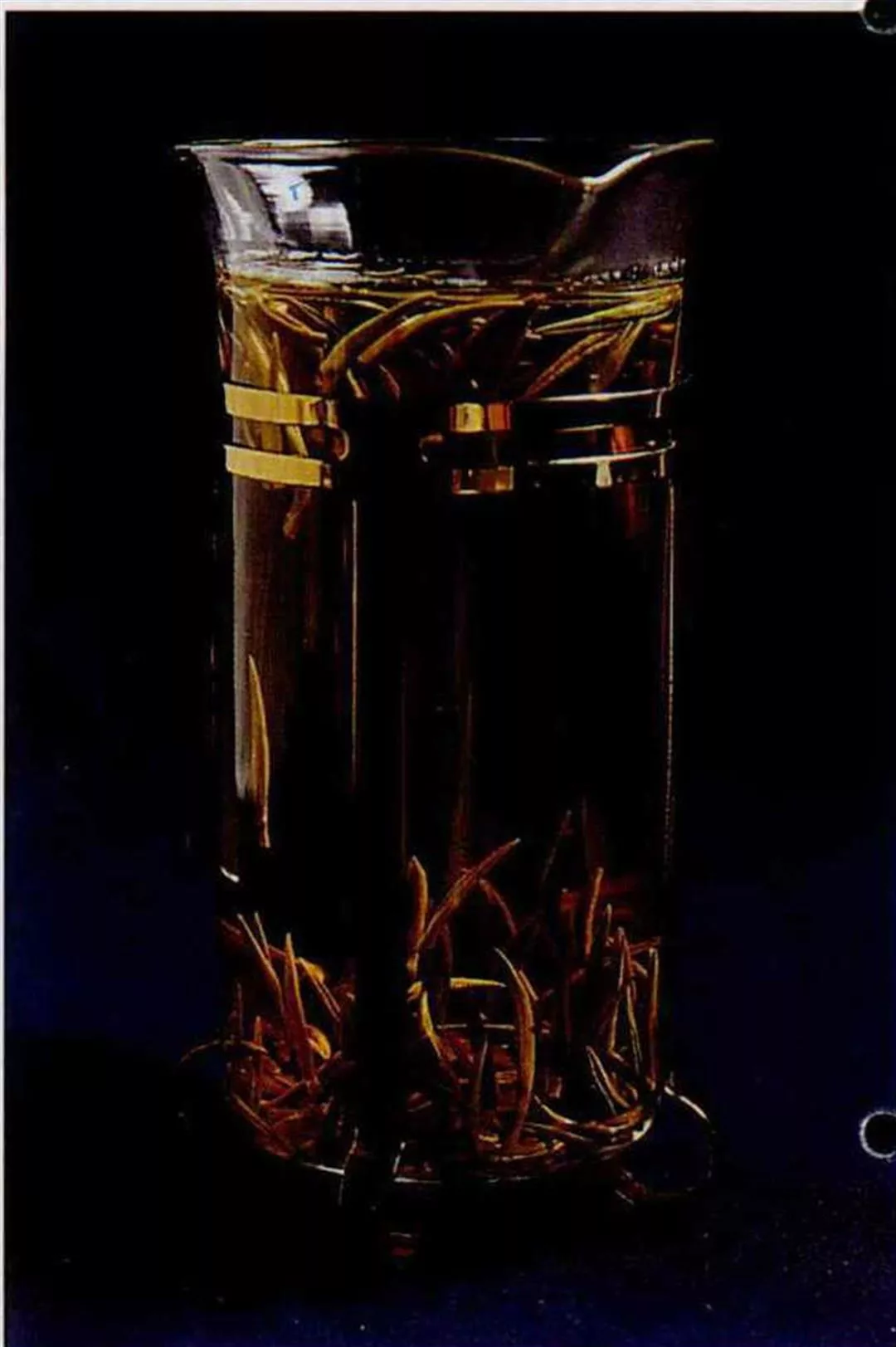
The Dance of the Tea Leaves! If you don't use a glass pot, you'll miss a dazzling ballet performance.
Red tea? Black tea?
The "black tea" generally drunk in the West is classed in China among the fully fermented "red" teas. China produces many such teas, the best-known being Congou, Souchong and Qihong. Green tea is processed without fermentation, and famous varieties include Longjing, Biluochun, Jiancha and Gunpowder. The third category, semi-fermented teas, include Paochong, Oolong, Tieguanyin and others, each of which is fermented to a different degree.
Cha Jing ("The Classic of Tea") by Lu Yu (733-804) of the Tang dynasty, categorized teas into coarse tea, loose tea, powder tea and brick tea, all of which were steamed green teas. Nowadays there are many ways of categorizing tea. For instance, according to the season when it is picked, it can be divided into spring tea, summer tea, autumn tea, tea picked before Qingming ("Pure Brightness," the 5th solar term, around 4 April), tea picked before Yushui ("Rain Water," the 2nd solar term, around 19 February), new tea (the current year's tea), old tea (tea from previous years), and so on. Teas can be divided according to their place of origin, such as Qimen (Keemun), Wuyi (Bohea) or Dongding; according to their shape, such as "silver needles," "sparrow tongues," "pearl" (known in English as Gunpowder) or "eyebrow"; or according to the variety of tea bush, such as Tieguanyin, Oolong or Shuixian. Also, "yellow tips" and "green snow" are named for their appearance and color, while "yellow brew" and "fiery green" are named for the color of their infusion; and the names of Shilixiang ("ten leagues fragrance") from Yunnan and Xiangchuan from Anxi describe their fragrance.
The best-known exported China teas are Lapsang Souchong, which is a Wuyi souchong black tea which is smoked with pine smoke during drying, giving it an aroma of pine resin; Congou, a carefully processed black souchong leaf tea grown at lower altitudes in the Wuyi mountains; Pekoe (meaning "white down"), named for the downy young bud tips used; and Gunpowder (zhucha, meaning "pearl tea") which is rolled into small round balls like pearls.
Oolong, on the other hand, is Taiwan's best-known export tea. According to research by Hsu Ying-hsiang of the Taiwan Tea Experimental Station, during the reign of the Qing emperor Xianfeng (1851-1862) the British merchant John Dodd came to Taiwan in search of camphor. But he discovered that there was great potential for tea production in Taiwan, so in 1866 he began buying tea on a trial basis, and also bought in tea saplings from Anxi in Fujian. He made loans to farmers as an incentive to grow tea, and the area planted with tea bushes expanded rapidly. In those days Taiwan only produced semi-processed "raw" tea, which had to be sent to Fuzhou or Amoy for final processing. In 1866 Dodd set up the first full tea-processing factory at Mengchia (now Wanhua in Taipei), and employed skilled craftsmen from Fuzhou to prepare Oolong tea. This marked the start of tea processing in Taiwan. In 1869, two clippers carried 2131 piculs of Taiwanese tea to New York for direct sale. To this day, Taiwan's Oolong tea has a high reputation in the West and some people even divide tea into three major types: black, green and Oolong.
On the other hand, the black tea mass-produced using modern Western machinery is divided into four main categories according to size and shape: leaf, broken, fannings and dust. "Dust" is mainly used in tea bags.

How can British tea-drinking culture be revived? Mr. Bramah hopes people can take the time to brew a cup of good tea and enjoy it with appreciation.
China tea? Indian tea?
Edward Bramah, director of the Bramah Tea and Coffee Museum in London, says that when he was trying to promote China tea in the 1950s, he discovered that only a few old ladies in Chelsea and Cheltenham still remembered the taste of China tea and were prepared to pay the high prices demanded for it by tea sellers. Today, he says, there are only a very small number of large hotels where at teatime one can still hear the waiters ask guests whether they would prefer China tea or Indian. When Britons speak of tea nowadays, they are almost always referring to black Indian tea, and they know as little about the many kinds of "China tea" as most Chinese know about the equally rich variety of "French wine."
So what is the most basic difference between China tea and Indian--or should we say English--tea? Mr. Bramah says the China teas most commonly known in Britain are categorized according to their place of origin or according to the tea variety, and are traditional hand-rolled leaf teas. But the machine-processed fully fermented strong broken black teas, categorized by shape and size, made in the British Empire in Assam, Darjeeling and Ceylon and even Africa from the latter part of the 19th century onwards, and blended to produce different proprietary tea brands, typify "Indian tea." But in fact, since the 1970s, a majority of the tea in teabags sold in British supermarkets has come from tea plantations in Africa.
Tait Marketing and Distribution Co., which imports English teas to Taiwan, says that Earl Grey is currently the main English tea on the Taiwanese market. But in the Bramah Tea and Coffee Museum, Earl Grey is categorized as a China tea.
Charles, the 2nd Earl Grey, who was British prime minister in the 1830s, is said to have been given the secret recipe for blending "Earl Grey Tea" by a Qing dynasty mandarin. This famous Chinese blend is one which many tea companies try to recreate. Twining's Earl Grey tea includes bergamot oil, which releases a citrus fragrance somewhere between lemon and grapefruit. Earl Grey is a very strong tea, and Mr. Twining finds it tastes best when one or two spoonfuls are added to another black tea.
Self-drinking tea? Brand tea?
For the Chinese, who choose tea according to the season it is picked and the way it is processed, to mix different teas seems almost unimaginable. Old tea farmers will still insist that tea picked on any one day should all be processed the same day. Tea containing leaves left overnight before processing can be recognized at the first sip.
"But you can only do that because you have the tea plantations on your own doorstep," says Mr. Twining. In England, this kind of tea is called "self-drinking tea" (meaning tea good enough to drink unblended) and is in very limited supply and extremely expensive.
Most proprietary teas on the British market are made from a variety of raw or processed graded teas which tea merchants buy from different Indian and African plantations or at tea auctions, and which are then carefully mixed and combined in varying proportions by professional blenders to create branded teas of stable quality, in flavors such as Earl Grey Tea, Breakfast Tea, Prince Charles Tea and so on. Mr. Twining says that for a country like Britain which does not grow tea but which consumes it in large quantities, tea blending is an essential process and is also a great skill and a matter of the highest commercial secrecy. The blends used in branded teas may contain up to 40 different individual teas.
Teabags? Instant tea?
Wu Chen-tuo notes that as early as the Song dynasty (960-1279) in China, the practice of brewing tea from leaves contained in a silken gauze bag is recorded. The teabags which account for such a large share of Western markets today had their origin at the end of the 19th century, when the New York tea merchant Thomas Sullivan placed individual portions of tea in silken bags for customers to sample before buying.
In the 1920s, teabags made of fine cotton muslin appeared; teabags made of strong long-fibered paper were successfully developed in 1945. But teabags did not really gain widespread popularity until the 1950s. At that time Nestle and Liptons also developed tea powder, and in the 1960s were already selling large quantities of granulated instant tea, although mainly in fruit flavors.
Edward Bramah puts the "teabag revolution" down to the growing importance of television in people's lives. People no longer had the patience to brew a cup of good tea, nor the time to sit down and enjoy it, and from then on were won over by the convenience of teabags, even though these "tend to create an extraordinary red colour in the cup, teapot and sink."
Mr. Bramah has made it his mission to revive tea-drinking culture in Britain. He opened his museum in a former tea importing warehouse on an old London wharf, and there he displays exhibits covering the history of tea, along with his collection of tea-drinking accoutrements. So can how tea-drinking culture be revived? Mr. Bramah believes that firstly one must break away from the teabag mentality, and sit down to patiently brew a cup of good tea, and then drink it with appreciation.
Earthenware pots? Porcelain pots?
When most Westerners brew black tea they like to use a white fine bone china teapot with a capacity of around four to six cups. However, when one visits lately homes or museums, one usually sees cabinet after cabinet of smaller earthenware and porcelain teapots. "That is because tea was rare and very expensive," is the explanation given by the guide at the British Museum. Today in the West very few people use unglazed earthenware teapots, as if moving from earthenware to porcelain were a natural progression. But the display cabinets in the stately homes also contain many small teapots imported from tea-producing China, and tea drinkers in Taiwan today still prefer small earthenware teapots.
"Someone who really knows tea can brew good tea in any pot," says Chang Kui-fu, owner of the Naimiao Tea Master Memorial Hall in Mucha. But naturally different types of tea are at their best when brewed in different utensils. For instance, when Mucha Tieguanyin tea or Taiwan Oolong is brewed in "purple clay" earthenware pots, the fine pores in the earthenware absorb the tea and hold its flavor, so these pots are most appropriate for these semi-fermented teas with their restrained aroma. Unfermented green teas and lightly fermented Paochong have a pleasing color and are thus best served in individual white porcelain cups. Broken black teas make a strong, red brew, and are indeed best made in non-absorbent, easy-to-clean white porcelain. And when one brews Silver Needle Pekoe, the silver needles dance in the water and stand erect on the bottom of the cup, so if one does not use a transparent glass cup or teapot, one will miss out on a dazzling ballet performance.
When one has found the tea one likes and the appropriate cups and teapot, how does one finally make good tea? For Western-style broken black teas, the golden rule is to first warm the pot with boiling water, a practice which is also followed by the Chinese. The formula for how much tea to use is "one spoonful per person and one for the pot." Then one pours in freshly heated boiling water and lets it brew for three to four minutes before pouring and adding lemon or sugar according to taste. Those who prefer to add milk should remember to pour it into the teacup before adding the tea.
The Chinese way of brewing tea has many variants according to the different types of tea used, but the basic rule of "3 grams of tea leaves to 150cc of boiling water" applies, although this can be adjusted according to individual taste and preference. For more lightly fermented teas, the water temperature should be reduced slightly to prevent bitterness and astringency.
Tea meal? Tea bath?
In 18th-century England, one lady is said to have boiled up a pound of tea leaves, thrown away the liquid and served the leaves to her guests with butter and salt, while another filled sandwiches with tea leaves. These practices caused much gossip, but in fact the use of tea as a vegetable is recorded long ago in China, and the various tea-based meals energetically promoted by the Taiwan Tea Experimental Station have been an eye-opener for many people. The golden-yellow "Fragrant Tea Brittle" made by deep frying a batter made with fresh tea leaves, flour and eggs, and the European "tea meals" mentioned above, are actually variations on a common theme. And there are many more examples, such as green tea salad, black tea smoked duck, Dongding bean curd, jasmine steamed fish, Longjing seafood soup and Tieguanyin stewed chicken. What with tea wine, tea steamed bread, tea noodles, tea biscuits and tea fruit jelly, one could compose a whole banquet of foods redolent with the fragrance of tea.
And after you have finished such a banquet, you can use tea toothpaste to prevent tooth decay, sleep on a tea-leaf pillow to ward off headaches, and if you are fortunate enough to live in a tea-growing area, and it would be nothing too far out of the ordinary if you took it into your head to use tea soap to have a tea bath.
[Picture Caption]
p.22
Taiwanese, a world language!? How do you say "tea" in French? Say it in Taiwanese dialect, and your pronunciation won't be far off.
p.23
Not all Western teapots are large, and not all Chinese teapots are small. But each is the way it is for a reason.
p.24
The Dance of the Tea Leaves! If you don't use a glass pot, you'll miss a dazzling ballet performance.
p.25
How can British tea-drinking culture be revived? Mr. Bramah hopes people can take the time to brew a cup of good tea and enjoy it with appreciation.


@List.jpg?w=522&h=410&mode=crop&format=webp&quality=80)


@List.jpg?w=522&h=410&mode=crop&format=webp&quality=80)