Mountain Kids on the City’s Edge: Education Can Be Fun
Vito Lee / photos Chuang Kung-ju / tr. by David Smith
November 2014


In recent years, discussions about education in Taiwan have always gotten around sooner or later to declining enrolments due to a falling birthrate.
But Hushan Elementary School, located in Taipei City’s Beitou District, has hit upon a formula for success that capitalizes on the school’s beautiful natural setting and close interaction with parents. The school is not losing students; to the contrary, enrolment is steadily growing. Parents in Taipei actually cross school district lines to get their children into Hushan Elementary, and a lot of white-collar foreign expats working in Taiwan send their kids to Hushan even though the classes are taught in Chinese.
On a quiet school campus at the foot of Mt. Shamao in Beitou, someone chants: “Bicycle, bicycle, rolling happily forward....” The chanting stirs excitement and breaks the wooziness of an otherwise soporific summer’s day. It’s coming from the famous musician Chen Ming-chang, who is standing on stage in a wooden classroom before 30 students. Around and around the classroom they go, hopping and chanting in Taiwanese, led by Chen. The kids call him “the Bicycle Man.” He strums a guitar to rev up the atmosphere.
Because his own child is enrolled at the school, Chen has done what many other parents there have done, by volunteering to contribute in his area of expertise. He shows up once a week to teach a performing arts class. He’s extremely popular with the kids. The Bicycle Man is followed by Jonah, a Canadian English teacher who teaches English songs. Jonah’s classes also go over quite well with the students.
Active parental involvement increases the school’s resources. At the annual school fair to celebrate the institution’s founding, students sing the school anthem: “Way deep in the mountains, lies a sparkling green lake....” Conducting the student chorus is none other than Fusao Kajima, the noted conductor of the National Taiwan Symphony Orchestra. A long-time resident of Taiwan, Kajima has decided to have his child stay here with him. Like others with children enrolled at Hushan Elementary, Kajima makes it a point to be present for school celebrations and sports-day activities.
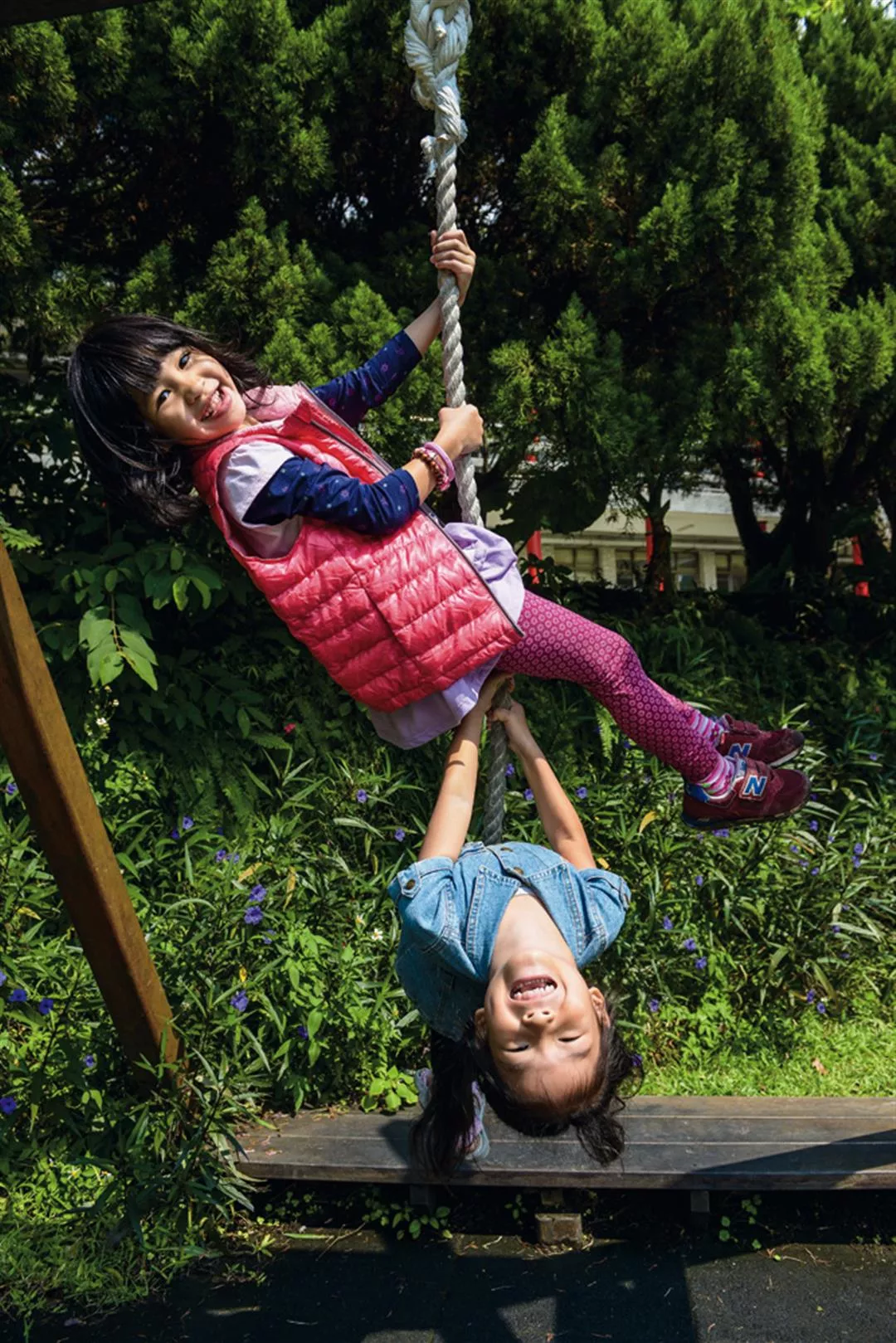
School lets out for the day at Hushan Elementary, and a bunch of happy children go racing about the ecological study areas and the school playground.
Located within Yangmingshan National Park, the view from the school is a vast sea of greenery, including the unmistakable conical profile of Mt. Shamao. “We all call ourselves the happy children from Mt. Shamao,” says Director Zhai of the Hushan kindergarten, who adds that the natural environment was long ago integrated into the curriculum at this semi-rural school of just 150 students.
Every spring, the hills are abloom with azalea and Taiwan cherry. Walking into the school’s 8,000-square-meter campus, one discovers that six special ecological study areas have been set aside for “woody plants,” “amphibious animals,” “ferns,” “nectar plants,” a “stream,” and a “wetlands.” Whenever the weather is good, this is the best place for the kids to learn about the ecology. Each summer, frogs croak incessantly in the school pond, which in turn attracts snakes to prey on the frogs. “So the kids at Hushan Elementary are all familiar with snakes,” laughs Zhai.
“Apart from such birds as the Formosan blue magpie, the Taiwan barbet, and the Formosan whistling thrush, we also frequently see all sorts of insects, butterflies, and amphibians. The kids can develop an understanding of different ecosystems and get a feel for biodiversity,” says Zhai.
In 2001 the school built a hot-spring pool, which the kids more often call the “foot-soaking pool.” The teachers and students all like to go there, and on weekends and holidays lots of people saunter into the school just to enjoy a soak.
According to Principal Lin Minzheng: “In addition to the natural beauty of the place, the special culture we’ve built up here is another attractive aspect of this elementary school.” The special culture of which he speaks is the close interaction between parents, students, and teachers.
Back in the 1990s, schools in urban Taipei had to turn students away because all their admission spots filled up regularly, while some schools on the outskirts had trouble finding enough students. The city government stepped in to remedy things, as Principal Lin explains: “To address the problem of dropping enrolments at schools up in the hills, and to provide families in the city with more education options for their children, the city government began promoting suburban and rural elementary schools. The first step they took was to subsidize school buses to make it easier to attend mountain schools—including Hushan Elementary. The natural environment here at Hushan is so good, and in recent years the thinking in educational circles has been that we need to reduce the pressure that students face and let them get closer to nature and learn from it. Thanks to trends like these, we long ago stopped having problems finding enough students, and in fact many of our parents have gone across school district lines to get their kids into Hushan Elementary.”
Says Lin: “We have all sorts of parents, but one thing they have in common is a love of nature. Some of them choose us so their kids can have lots of freedom and learn in a stress-free atmosphere. And there are parents who support progressive ideas that have gained currency recently, such as the idea of sustainable management of nature and the land. These are some of the factors that move parents to choose Hushan Elementary.”
Over 80% of the students at Hushan Elementary live in other school districts. Most are from the nearby districts of Shilin and Beitou, but some come from farther away, such as Luzhou and Xizhi in New Taipei City. The school’s natural environment has even induced foreign expatriates in Taiwan to enrol their kids there. Many of these parents live in nearby Tianmu, where there is an especially high concentration of white-collar foreigners. Over 20 of the 150 students at Hushan are foreign nationals from more than ten countries, including Japan, South Korea, Sri Lanka, France, and Canada.
“When I first took the job as principal here three years ago,” laughs Lin, “I was often unsure whether adults I saw on campus were visitors or parents.” Later, he discovered that lots of parents, after dropping off their kids, would stick around. “Some are full-time mothers who take part in some way or other in school activities until it’s time to take their kids back home.”

School lets out for the day at Hushan Elementary, and a bunch of happy children go racing about the ecological study areas and the school playground.
Parent participation is a trend in education, but it is rare to see parents spending as much time as they do at Hushan Elementary, let alone actually teaching classes. Lin explains that Hushan happens to have parents with professional expertise in many different artistic fields, and the teachers are very happy to let the parents pitch in: “The parents and teachers coordinate with each other so that the children can be stimulated by art and nature. This is a good thing.”
“We are very lucky, because some our of parents are heavyweights in their fields. We respect their expertise, and trust them in the classroom.”
In addition to teaching in one’s specialty, there are also parents who take part in after-school tutoring to help the slower students with their homework. The result is a “golden triangle” of learning formed by the teachers, children, and parents. At a time when a falling birthrate is making it difficult for institutions from elementary school through university to fill their classrooms, close cooperation between parents and teachers has enabled Hushan Elementary to buck the trend and actually grow. In the past three years, enrolment has increased from 130 to 150. When it comes time to admit new kindergarten and elementary students each year, there are always more applicants than available spots. Parents draw lots and hope for the best.
Thanks to the small number of students, Hushan Elementary has been able to develop a joint evaluation system that puts more emphasis on self-expression than on written tests. Says Lin: “When our students share experiences from a trip abroad or report on something more local, such as Taiwan’s indigenous cultures, they direct their presentations to both teachers and the other students so that evaluations are coming from both sources. We’ve implemented this aspect very thoroughly.”

Students listen intently as their teacher explains: “Look closely—you’ll see there are tadpoles and insects in there!”
In addition to the natural environment and parent participation, another unusual feature of Hushan Elementary is the strong emphasis it puts on international exchange.
“In this age of globalization, one important measure of a country’s degree of integration into the global community is whether its children are capable of adapting with ease to life in different countries,” explains Lin, adding: “We don’t feel that elementary school is too early to get involved in international exchange.”
This last May, a group of 13 fifth-graders from Hushan Elementary went on an eight-day cultural study trip to Chinese International School (CIS) in Hong Kong. The children stayed with families in Hong Kong and attended regular classes. The completion of coursework in Hong Kong was only half of the project, however; a week later, a group of students from CIS came over to Taiwan to attend classes at Hushan Elementary, hosted by the local students and their families.
The exchange program between CIS and Hushan Elementary, which has been running for years, affords the children from Hushan Elementary a chance to see how their peers in an international metropolis like Hong Kong live. According to a parent of one of the students who has taken part in the exchange program: “Every student at CIS can speak at least three languages. The environment is very different than in Taiwan. Experiencing the cityscapes of Hong Kong, and the lifestyles there, is an eye-opener for the kids from Hushan Elementary, and a chance to grow.”
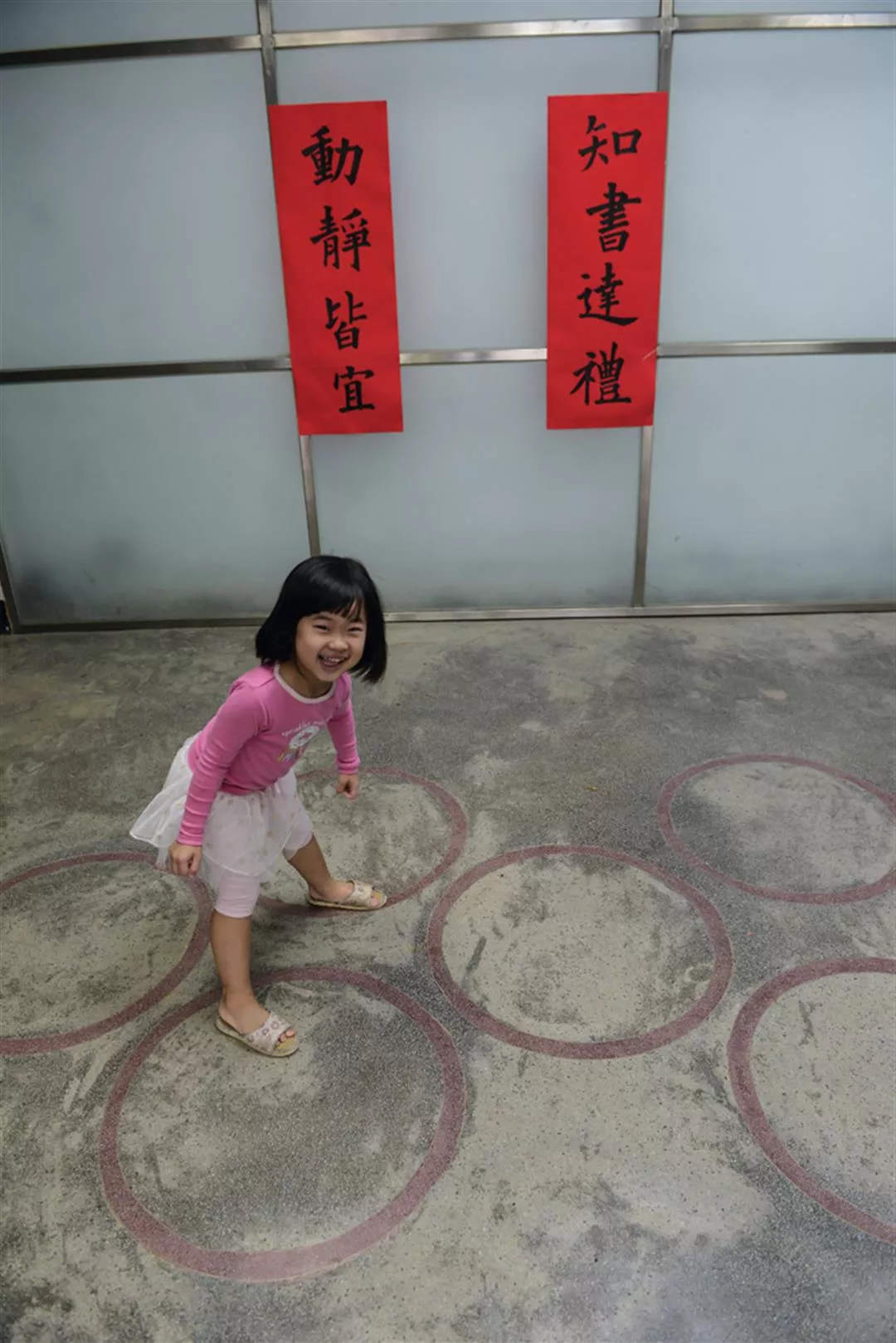
This couplet at Hushan Elementary encapsulates what the school is all about: “Study well; do what is proper.” “Know when to act, and when to be still.”
The important role of nature at Hushan Elementary, the school’s emphasis on a happy learning experience, and the close cooperation between parents and teachers, have attracted a great deal of attention. This is all a reflection of the strong desire of parents for a new way of education. But that doesn’t mean that all the parents are completely on board with the way things are done. Once, for instance, a man who had just escorted his grandchild to school stopped in at Lin’s office and said: “Principal Lin, this is no way to teach children. After my elder grandson graduated from here, he was way behind the other children in junior high.”
The school is aware, in fact, that graduates do have an adjustment period to go through after enrolling at a junior high school in the city. And there are parents who feel that spending an entire month on inter-school and international exchanges affects academic performance.
Lin acknowledges that in his three years at the school he has indeed heard these sorts of complaints. But international exchange has become a Hushan tradition that is strongly supported by teachers and students alike: “Why should we ape the values of other schools?”
The Hushan experience has given rise to numerous questions. How does a school educate in a happy, stress-free atmosphere without sacrificing academic performance? How are children to learn the rules of politeness and etiquette when the focus is on communing with nature? In such a freewheeling environment, where is the line between showing students respect and letting them run wild? That such questions are asked does not necessarily negate the school’s efforts, but finding effective answers is critical to the continuation of support for the Hushan approach. Indeed, such questions cut to the very heart of education.
Lin explains his thinking: “Different parents have different reasons for enrolling their children here. We have to maintain the values that attract people here in the first place. But we also have to keep searching for our core values. Especially when your basic philosophy of education emphasizes human values, human concerns, respect for the natural environment, and sustainability, you really have to do a solid job with the fundamentals. That’s the only way you can continue with this approach and win people’s support.”

School lets out for the day at Hushan Elementary, and a bunch of happy children go racing about the ecological study areas and the school playground.

School lets out for the day at Hushan Elementary, and a bunch of happy children go racing about the ecological study areas and the school playground.


@List.jpg?w=522&h=410&mode=crop&format=webp&quality=80)